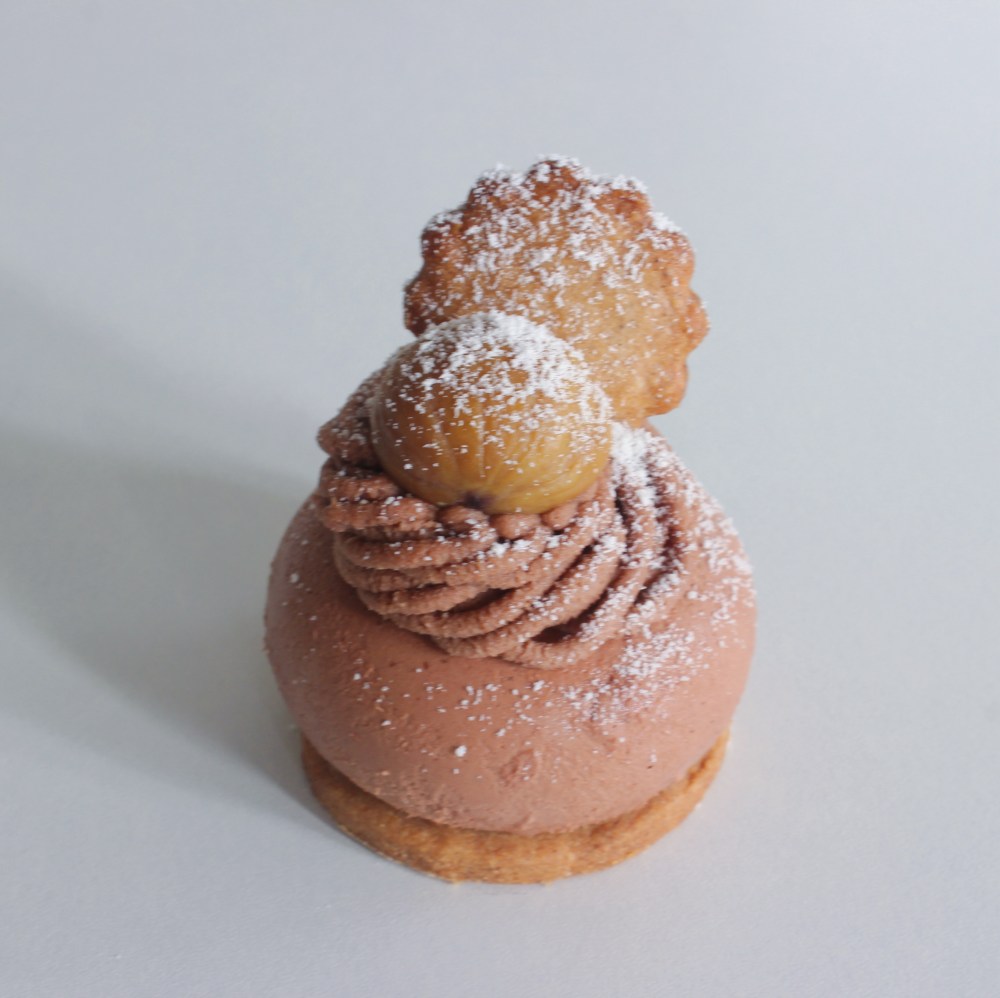
Mont Blanc is a French chestnut dessert, usually consisting of chestnut cream, piped in a string-like matter to resemble the peaks of a mountain, and finished with a dusting of confectioner’s sugar to effect snow tops. Mont Blanc is literally French for “white mountain” for that reason. While the dessert is French in origin, it has been popularized in Japan as well. I personally grew up eating Mont Blanc from my local Asian bakery, which consisted of a light chocolate cake stuffed with chestnuts and cream, and topped with more chestnut cream to finish. My mom used to get me them all the time as an afternoon school snack, back when I was first learning how to bake. My initial exposure to Mont Blanc was watching an episode of Yumeiro Patissiere, where they were making some with a financier as a base. While my norm with Mont Blanc is that there is a cake-like component at the bottom of the chestnut cream, I’ve seen tarts, parfaits, ice cream sundaes, all classified as Mont Blanc because of the cream on top. So it is a pretty versatile dessert in that you can make all kinds of desserts that fall under the Mont Blanc umbrella! For this specific recipe, it is my slightly-more festive take, featuring a homemade chestnut biscoff cookie base and garnish for that holiday cookie feel, a rich chocolate mousse, a light chocolate-chestnut chiffon, and a chocolate-chestnut puree. Instead of powdered sugar, I used a brown sugar “snow” using tapioca maltodextrin, just to keep the dessert from being too sweet, something I find you run the risk of when you’re caking something in 10x(a fancy industry term for confectioner’s sugar because it’s sugar that has been processed 10 times for that fine, powdery texture).
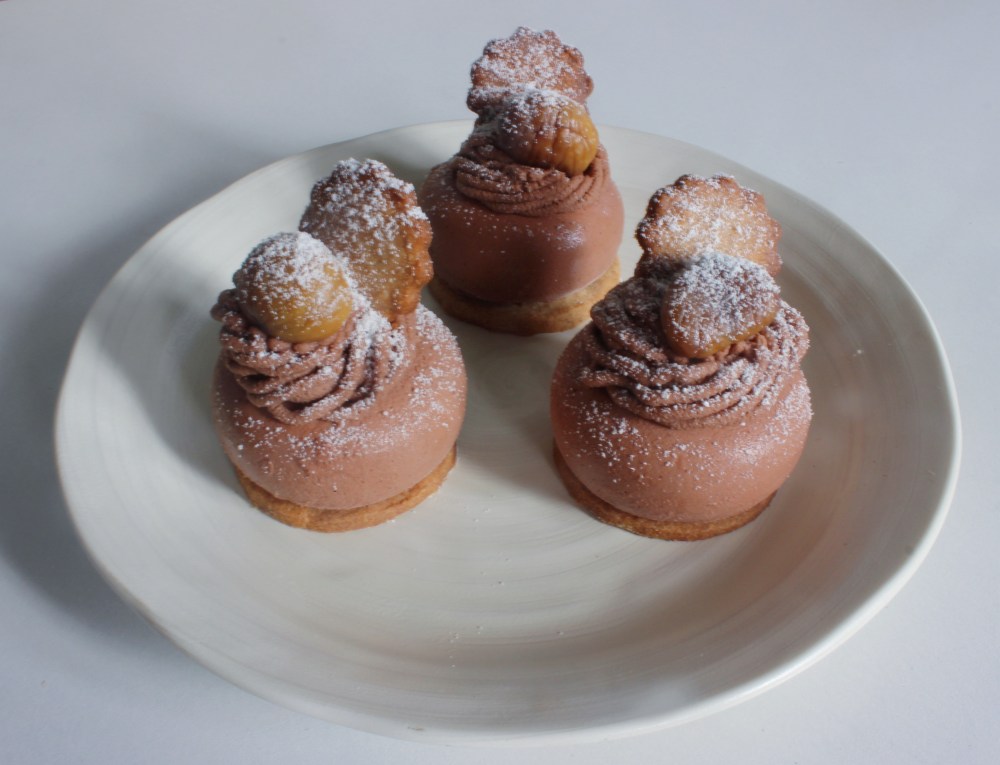
For the components, we have a chiffon cake batter, a biscoff cookie dough, chocolate mousse, a soak, a chestnut-chocolate puree, and brown butter snow. Complexity-wise, this dessert may take up to two days, since there is a lot of chilling between preparing the chestnut-biscoff cookie, baking off the chiffon cake, and freezing the chocolate mousse to set it. Throughout my recipe, I use chestnut flour in lieu of some of my all-purpose. Chestnut flour lacks gluten, but it adds a toasty, warming flavor to my baked goods, making it a wonderful addition to any holiday-themed dessert such as this one! The one drawback is that the absence of gluten can cause doughs to be a lot softer and harder to work with. The cookie also is flavored with a lot of warming spices, just to make it taste exactly like a chestnut-flavored biscoff cookie! Unlike the light challenges with working chestnut flour into a cookie dough, the upside of making a cake batter with it is that such a batter yields a more tender crumb. For the chocolate mousse, it is a pretty easy mousse recipe to make. I use gelatin so that the mousse can set and stay firm even after it is unmolded. Because I wound up with a lot more chocolate mousse than needed, I wound up blending the leftover mousse, or at least a portion of it, with chestnuts to make a chocolate-flavored chestnut cream, just to tie in with the fact that chocolate was used throughout a lot of this recipe. For the chestnuts themselves, I was able to buy pre-peeled, pre-roasted chestnuts at my local Asian grocery store, which made it a lot more convenient when it came to processing them for the cream. The snow is super easy to make as well, since it just requires mixing brown butter and tapioca maltodextrin into a fine powder. This recipe still takes a decent chunk of time to execute and I wouldn’t say it’s the easiest to make, but it makes for a gorgeous petit gateau that is perfect for the winter!
Makes 8 servings:
For the chestnut-chocolate cake:
4 egg whites
1/4 cup granulated sugar
2 egg yolks
2 tbsp vegetable oil
a pinch of salt
1 tsp vanilla extract
1/2 cup chestnut flour
1/2 cup all-purpose flour
3 tbsp black cacao powder
1/2 tsp baking powder
In a bowl, whip egg whites with sugar until stiff peaks form. In another bowl, whisk egg yolks, vegetable oil, salt, and vanilla until combined. Sift into the egg yolks your remaining ingredients then fold into that the egg whites to form your batter. Pour the batter into a lined quarter sheet tray and spread into an even layer. Bake at 350 degrees F for 20 minutes. Cool completely and cut out 2-inch disks out of the cake, 16 in total.
For the chestnut Biscoff cookie:
3 tbsp chestnut flour
3 tbsp all-purpose flour
1/4 tsp baking powder
2 tbsp dark brown sugar
1 tsp vegetable oil
2 tbsp unsalted butter, browned
1 tbsp cold water
a pinch of salt
2g ground cinnamon
1g ground nutmeg
1g ground clove
1g ground ginger
1g ground cardamom
In a bowl, mix everything until combined into a dough. Refrigerate the dough for 20 minutes. Then on a floured surface, roll out the dough to 1/16 inch-thickness. Cut out 8 2-inch disks, and with the rest, cut out 8 more 1-inch scalloped disks. Place the disks on a parchment-lined sheet, spaced 1 1/2 inches apart. Bake the 2-inch disks at 375 degrees F for 12 minutes, and the scalloped disks at the same temperature but for 8 minutes instead. Allow the cookies to cool before using.
For the chocolate mousse:
8oz dark chocolate
1/4 cup whole milk
2 tsp gelatin powder
a pinch of salt
1 tsp chocolate liquor
8oz heavy cream, whipped stiff
In a bowl over a double boiler, melt the chocolate completely. In a pot, dissolve the gelatin, milk, and salt together. Pour the warm milk into the chocolate and stir until combined. Allow the chocolate to cool to lukewarm before adding in the chocolate liquor, then folding into that the whipped cream to finish. Transfer to a piping bag, reserving 1/4 cup of the mousse for the chestnut puree.
For the soak:
1/4 cup whole milk
1 tsp instant coffee
a pinch of salt
Stir everything together until combined.
For initial assembly:
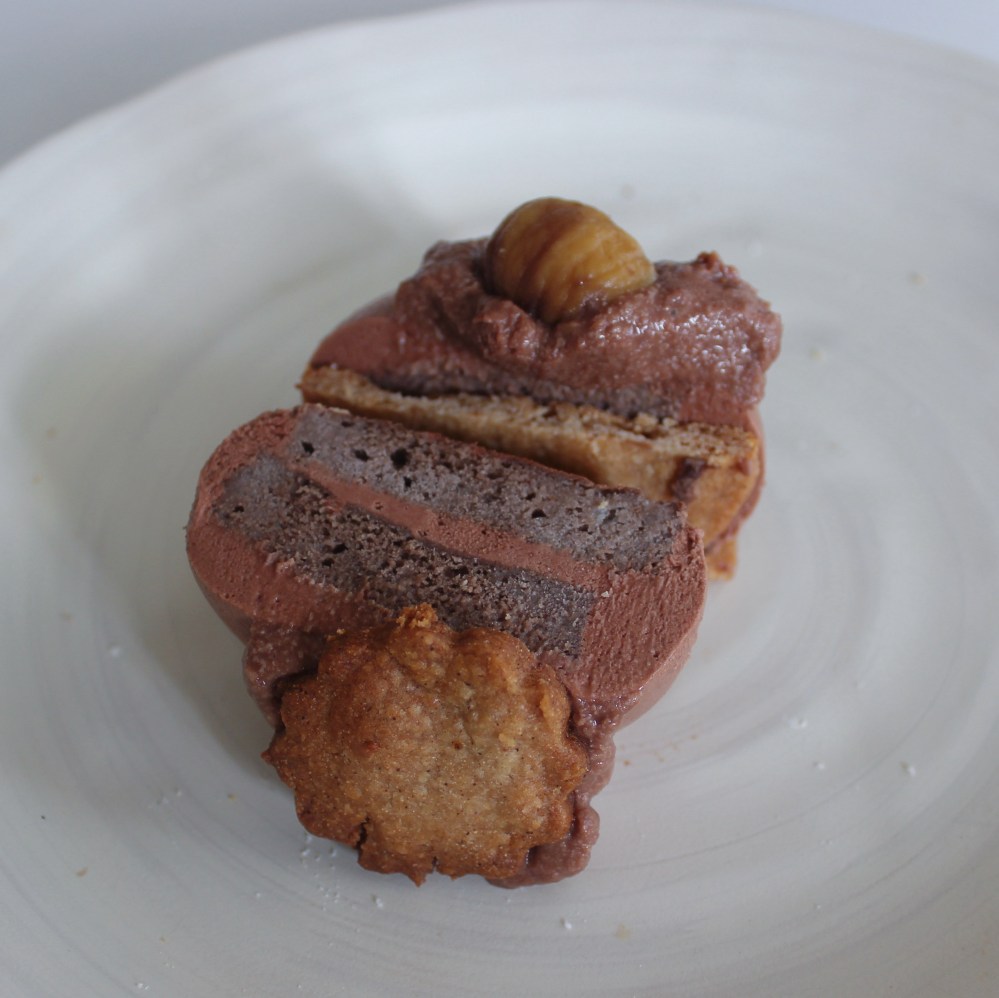
Start by filling 8 petit gateau molds 1/3 the way with the chocolate mousse. Brush soak onto half of your cake disks and press into the mousses. Pipe the molds another 1/3 the way up and repeat the soaking and pressing of another round of cake. Pipe in more mousse as needed to fully fill your molds. Level off any excess mousse, and transfer the molds to the freezer for 2 hours before attempting to unmold.
For the chestnut-chocolate puree:
1/4 cup chocolate mousse
2oz roasted and peeled chestnuts
1/4 cup heavy cream
1 tsp vanilla extract
a pinch of salt
In a pot, bring everything to a simmer until the liquid is cooked by half. Transfer to a blender and cover the top with two layers of towels. While pressing down the blender lid with the towels to prevent a blender explosion, puree the chestnuts and heated cream until a smooth puree forms. Pass through a sieve to remove any lumps. Transfer to a piping bag with a large set spaghetti tip.
For the brown butter snow:
1 tbsp unsalted butter, browned
a pinch of salt
1/2 cup tapioca maltodextrin
In a bowl, mix everything until a clumpy powder forms.
For garnish:
Roasted chestnuts, peeled
To assemble, start by unmolding your petit gateau mousses and inverting them onto the larger chestnut biscoff disks. Pipe on top of that your chestnut-chocolate puree, and garnish the tops with the smaller biscoff cookie and the roasted chestnut. Sprinkle over that the snow to finish.
 Freddy's Harajuku