A while back, my mom gifted me with a mango, which is a fruit I admittedly don’t eat that often – I usually have bad luck with mangos, since most of the time, the ones I pick out are too unripe and sour, and I usually want super ripe ones for the kinds of desserts I make. Mango can be fibrous, crunchy, and sour if unripe, or sweet, juicy, and tender, all ideal traits for a dessert, if it is ripe. Fortunately for me, since I forgot about the mango for about 3 weeks, it had plenty of time to reach peak ripeness, and I got a sweet, delicious, tender mango that I was excited to bake with. My first thought was to go with mango sticky rice, or some kind of coconut mango sago situation. But that sounded too expected, so I wanted to go a different route. I also happened to have lucuma(a fruit from the Amazon that tastes like caramel) puree in my freezer, so I wanted to do something with that, the mango, and mochiko, to be a play on mango sticky rice. You can get frozen lucuma puree from most Latin grocery stores – I actually purchased mine from a local Argentian bodega! I also just traveled to San Antonio, Texas, to see the total eclipse, and I figured, why not use that as a visual inspiration, and make a dessert that resembled the sun? And that was how this dessert started to take shape!
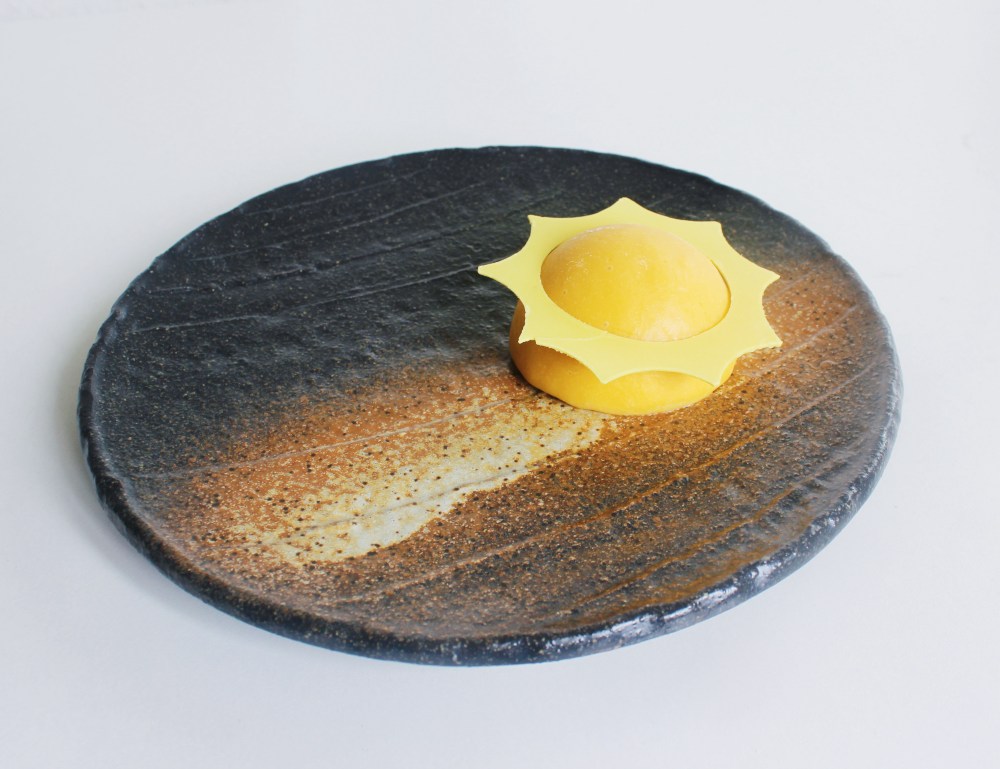
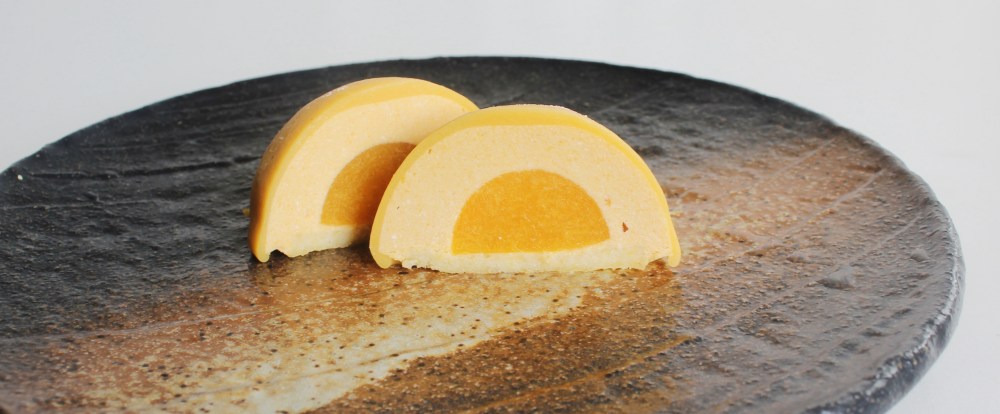
For the components, we have a mango-lucuma mousse, a sticky rice chiffon cake, a mango core, a mango glaze, and a dulcey(blonde chocolate) garnish. Technically, this dessert is pretty challenging – there is a lot of different temperatures that need to be tracked, suck as the core needing to be frozen solid first, and then the mousse needing to be frozen solid too before you can glaze the whole thing, and then the glaze needs to be set before you can even adorn the cake with the garnish. With the garnish itself, I spent 2 hours trying to get more than 2 successful attempts at those tempered dulcey halos. I would suggest using tuile molds instead if you can, but I was free-handing it with acetate and ring molds, and it was a literal pain. I would recommend using the dulcey to make a different shape entirely, since while the halos are fun and cute, they were NOT worth the anguish I experienced of having to temper, spread, set, cut out, and attempt to carefully unmold these halos, and watch them crack or fracture from being too thin. That being said, I am just glad I was able to get at least one presentable one for this post. Other fun facts, since this dessert used mochiko for the chiffon cake, the cake itself is 100% gluten-free! So there is that pleasant surprise to it as well.

Makes 4 servings:
For the mango puree:
1 ripe mango, peeled and de-seeded
2oz water
a pinch of salt
Puree the ingredients together to form your puree.
For the mango core:
2oz mango puree
a pinch of salt
1 tsp sugar
1 tsp agar agar
In a pot, heat up everything until the agar and sugar are dissolved into the puree. Pour the puree into 1-inch half sphere molds and freeze those solid before attempting to unmold.
For the sticky rice chiffon cake:
1 egg white
1 tbsp granulated sugar
1 egg yolk
1 tsp canola oil
1 tsp vanilla extract
1 tbsp milk
1/4 cup mochiko
1/4 tsp baking powder
a pinch of salt
In a bowl, whip the egg white with sugar until stiff peaks form. In another bowl, mix the egg yolk with the canola oil, vanilla, and milk. Sift into that the mochiko, baking powder, and salt, and fold into that the whipped egg whites. Pour the mixture into a lined quarter sheet tray, and spread into an even layer. Bake at 350 degrees F for 15 minutes. Allow the cake to fully cool before cutting out 2.5-inch disks of the cake.
For the lucuma-mango mousse:
3oz lucuma puree
3oz mango puree
1 1/2 tsp gelatin powder + 1 tsp cold water
2 tbsp granulated sugar
a pinch of salt
4oz heavy cream, whipped stiff
In a pot, heat up the two fruit purees, the gelatin, sugar, and salt, stirring constantly until everything is dissolved together. Allow the purees to cool down to room temperature before folding the cream into them to form your mousse. Transfer the mousse into a piping bag.
For initial assembly:
Start by half-filling 4 3-inch half sphere molds with the mousse. Press the frozen cores into the centers of each mousse, then level off the molds with any remaining mousse and the chiffon cake disks. Freeze these mousse cakes solid, at least 3 hours, before attempting to unmold. Keep the mousse cakes frozen solid for the glaze.
For the mango-dulcey glaze:
4oz mango puree
2oz milk
2oz dulcey
1 tsp gelatin powder + 1 tbsp cold water
In a pot, heat everything up on low heat until everything is melted together. Allow the glaze to cool down to 90 degrees F before pouring over your frozen-solid mousse cakes. To glaze, place the mousse cakes onto an icing rack or on top of small ring molds(some kind of elevated surface where the edges of the mousse cakes aren’t touching the ground) and pour the glaze on top, allowing the excess to drip off and the glaze to set before transferring the cakes to a serving surface.
For the dulcey garnish:
4oz dulcey, in four parts
In a bowl on a double boiler, melt three parts of the dulcey. Take the dulcey off heat and stir in the rest until that is melted in as well. Spread the dulcey onto acetate in an even layer and allow it to partially set at room temperature for 5 minutes. Start by cutting a 4.5-inch disk, and a smaller 3-inch hole in that. Cut out pieces from the edge using the side of a .5-inch ring mold to form the ridges of the ray, and then allow the dulcey garnish to refrigerate until it can pull from the acetate. Re-melt the dulcey and repeat these steps until you have four garnishes to use.
 Freddy's Harajuku