Langue de chat are a thin French cookie, similar to like a tuile, or a Milano cookie. The translation to English is rather unappetizing, meaning “cat tongues”, but I can assure you that these cookies are quite addictive. In Japan, a popular method of preparing them includes baking them into ornate squares, and sandwiching them around a square shaped tile of either buttercream or chocolate ganache. I found myself eating maybe 5-6 of those langue de chat cookie sandwiches in one sitting because of how delicious as well as surprisingly un-filling they were. For this iteration of langue de chat, I wanted to pull from another inspiration, being those maple sandwich cookies. I’m not sure how many people have grown up on these, but those maple leaf-shaped cookies with a creamy maple filling were my literal childhood. Probably because we used to go to Canada a lot when I was younger, and also because those cookies were somehow always lying around my house as a kid. Since the only other sandwich cookies I grew up on were Oreos and Nutterbutters, and I have done so many things with Oreos, I felt like it would be nice to go with something maple-flavored for a change, since it definitely has been a while since I last made a maple dessert of any kind!

For the cookies themselves, I actually found myself having to experiment quite a bit with the batter. Since I have using these fairly thin square stencils, I noticed that the baking time was extremely sensitive with these. My first batch, I baked at 400 degrees F for 10 minutes. And they all actually burned. Then I tried 375 degrees F for 6 minutes with my second batch. And they were a bit blonde, so I left them in for another 2 minutes, and they got too dark. Ultimately, what worked for me was 375 degrees F for 7 minutes. My way of permanently remembering this is that 7 is a lucky number! The other thing worth noting is the maple syrup. Now, you can substitute the maple syrup with maple sugar, and the recipe will still work as planned. I did the opposite and tried doing egg white powder with just the maple syrup, but I found myself needing to still add about 2-3 tablespoons of water to the batter to thin it out enough to a spreadable consistency. In either case, those are some substitutions you can do, though for convenience, I listed out the recipe as if you only had maple syrup and regular eggs on hand, since that would be what is the most accessible to you in a grocery store. I also highly encourage you to rest the batter before spreading it, or else the cookies will contract when you try to spread it, which will result in you needing to use more batter to fill each stencil. I encourage using the stencils, just because they will give the cookies a gorgeous square shape, but you can also pipe the cookies into a circular pattern, worst comes to worst.
For the filling, I went with a maple French buttercream. This was a for a few reasons. The langue de chat sandwich cookies I ate in Japan were made with a chocolate filling. However, there really wasn’t a good chocolate medium where maple flavor could be carried through – white chocolate would be WAY too sweet with maple, similar could be said to blonde chocolate, and Almond Inspiration, while delicious and it probably would be the most complimentary to maple, could still run too sweet/the almond would just take away from the maple flavor. The other reason was that since the batter used an egg white, we had a leftover egg yolk, and because French buttercream is made with egg yolks, that just made sense to just go that route. I also included the option to use bourbon or apple brandy as well, since that flavor profile adds some complexity to the filling, a more autumnal flavor profile, and it tones down the cloying sweetness of the maple as well. Now you don’t have to use the alcohol in this recipe, but I will say that the apple brandy in particular adds a fragrance and this almost autumnal comfort(which makes sense since apples are so prominent in the fall), that really perfumes the maple. The filling may start a little sweet, but as it mellows out, the scent of maple and apples linger, and it is really quite pleasant!
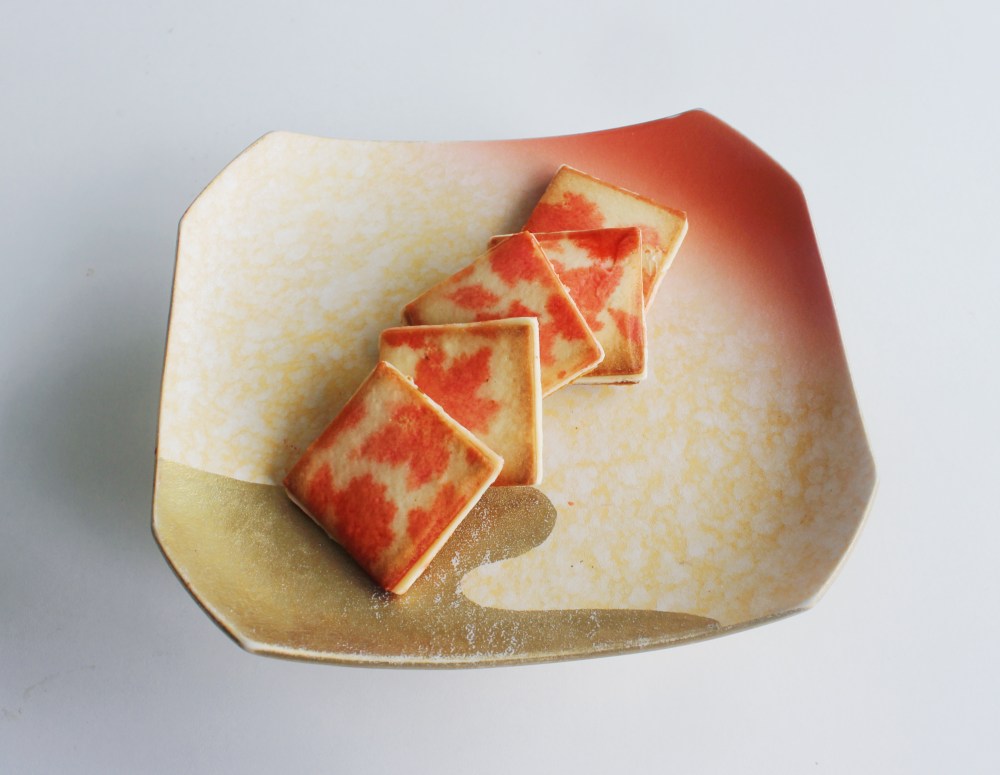
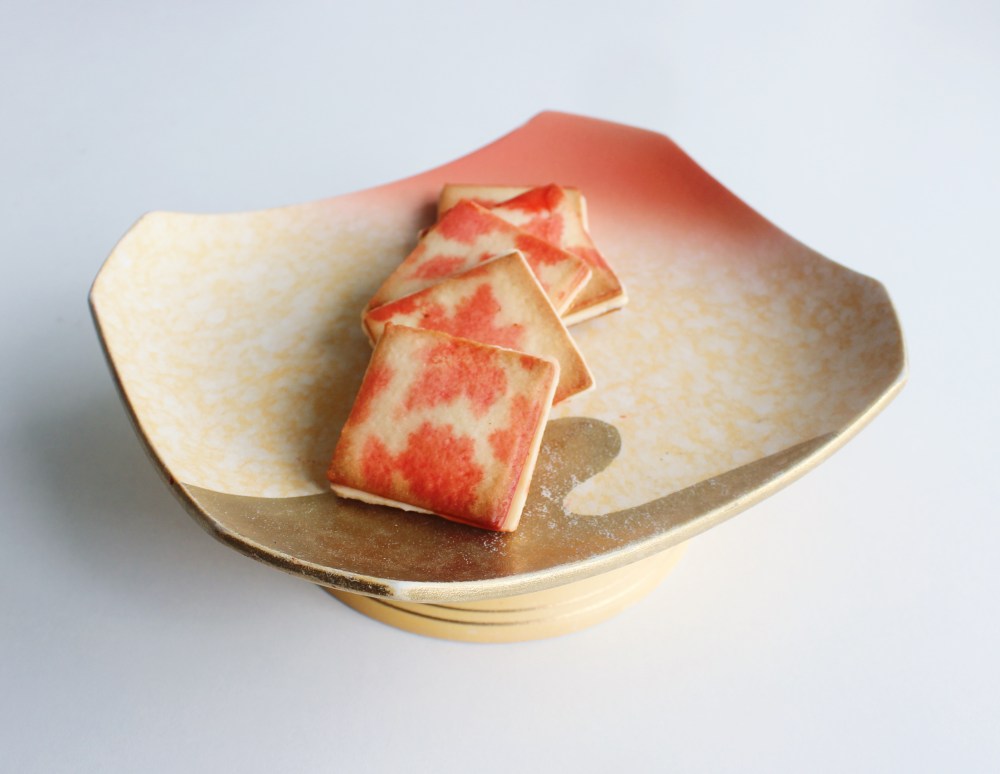
For the dye, I did initially start with using beet root powder instead of red food coloring, but I ran into several issues. The powder, even when finely strained out of the dye, still got caught in the nozzle of my spray bottle. And even when the dye managed to come out, the cookies that I applied the dye to had this weird, jammy red texture on them that hardly resembled the maple leaf pattern I was going for. So I had to nix the beet powder in favor of the red gel food coloring, even though I really wanted that for both the autumnal feel and the natural red color. The other note is that in my initial successful run at making these, I sprayed on the dye last, after I assembled the cookies. However, doing so meant that the dye has less time to dry out and firm up, since there being buttercream between the cookies meant that they could not be reheated or dehydrated for a little bit. For my recipe below, I modified the steps, so that you will be applying the dye on the cookies before assembling them with the buttercream filling. This way, the dyed cookies can be re-baked at a low temperature in the oven, just to set the dye into them. I used alcohol to make that dye mixture anyways, so just a little heat will allow that to evaporate and leave behind just the red maple leaf pattern as intended!
For reference on which molds I used for this recipe, I used these square stencils for the cookies, and these stencils for the maple leaf pattern.
Makes 22 to 24 cookie sandwiches
For the cookies:
3 tablespoons butter, room temperature
1.5oz maple syrup
1 egg white
1/2 teaspoon vanilla extract
a pinch of salt
1/2 cup all-purpose flour
In a bowl, whip the butter, maple, egg white, vanilla, and salt together until combined. Fold into that the all-purpose flour to form your batter. Allow your batter to rest for at least 1 hour – this will help the batter from contracting when you are spreading it. Spread the batter onto a parchment or silicone-lined sheet tray using a square cookie stencil. Repeat this process until you have used up all your batter. Bake the cookies, one sheet tray at a time, at 375 degrees F for 7 minutes. Allow the cookies to fully cool before attempting to use.
For the maple French buttercream:
1 1/4oz maple syrup
A pinch of salt
1 tbsp bourbon or apple brandy*
1 egg yolk
1/2 stick unsalted butter, room temperature
1/4 tsp vanilla
In a pot, bring the maple, salt, and/or bourbon/apple brandy to a simmer. Pour that liquid over the egg yolk and being whisking until combined. Whisk into that the butter and vanilla, whipping until everything has been mixed together into a homogenous, creamy, smooth mixture. Using the same square stencils as with the cookies, spread the buttercream into the stencils onto a nonstick surface(preferably parchment, but silpat works too), repeating until you have used up all of the buttercream. Freeze the buttercream for at least 30 minutes, if not longer, before attempting to press between two cookies.
For the edible paint:
1-2 dots red gel food coloring
Clear alcohol or apple brandy
The specific quantity of alcohol will entirely depend on the size of spray bottle you have on hand. I used a really small one, which ended up requiring about 3 tbsp of alcohol to 1 dot of gel food coloring, but again, that will vary. Arrange half of your cookies(these ones will be for the top/presenting side of the sandwiches) underneath the stencil, and then spray with the dye. Let the cookies dry out in a 200 degree F oven for 15 minutes, then let them cool.
For assembly:
Carefully place the buttercream onto one cookie and then press on the other cookie to form your sandwiches.
 Freddy's Harajuku
2 Comments Add yours