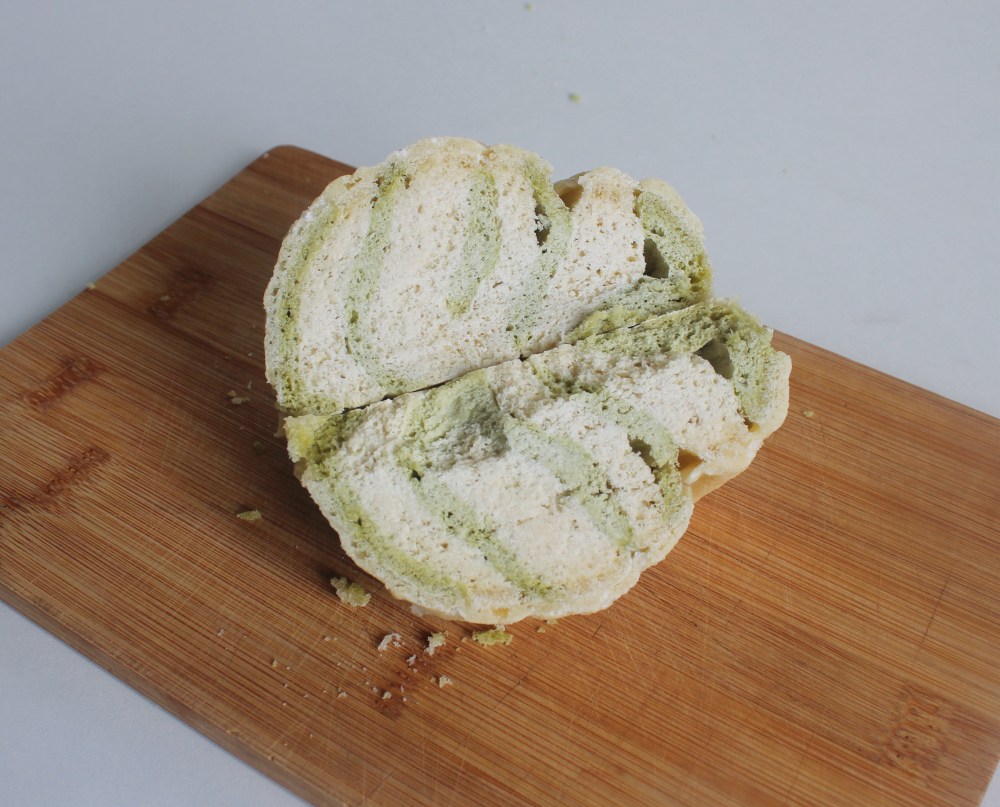
So I was not actually trying to make concha originally. These were going to be swirled matcha melon pan, but what ended up happening was that between how I was attempting to swirl my matcha and regular bread dough together and how my topping dough baked, I ended up with breads that looks like conch shells and that is what we are going with here. In Mexican cuisine, there is a very similar dessert to melon pan called conchas, which is a sweet bread that is also baked with a cookie-situation on top. So since I coiled my bread doughs for that rippled cross section, the actual doughs ended up baking out to have a swirl and it literally looks like a conch shell, so concha is a pretty apt description here. While these ended up being melon pan fails, they are still quite delicious – the dough is soft and spongy, and the topping, being a loose cookie dough that was rolled in sanding sugar, has a pleasant sweetness, butteriness, and the crunch of the sugar provided a great textural contrast to the bread itself!

For the recipe itself, we are making a yeasted milk bread dough, which starts with a tangzhong or a cooked flour mixture. It is important to do this so that the bread is soft and spongy, and so the dough does not dry out as quickly. Since the dough is yeasted, temperature control is important. Allowing the tangzhong to cool down before adding the yeast is crucial, otherwise, the heat from the freshly cooked tangzhong could damage or even kill the yeast. Instead of making two batches of dough, I made a large batch of milk bread dough, split that in half, and flavored half of it with the matcha powder, just to have a classic dough and a matcha dough. To achieve that coil, I laid the doughs on top of each other, cut them into strips, and rolled those. The cookie dough is similar to a butter cookie dough, being made with whipped butter, sugar, an egg, and flour. The cookie dough, or topping dough as I refer to it in the recipe, is then wrapped around the coiled bread doughs, and the whole thing is rolled in sanding sugar, which adds another layer of sweetness, which the bread dough itself will lack, and texture, since sanding sugar adds a pleasant crunch. I happily dub this recipe a pleasant accident, since we still ended up with something tasty, even if it was not the matcha swirled melon pan I had originally envisioned making!
Makes 8 portions:
For the bread dough:
4 cups all-purpose flour, in 4 parts
1 cup milk
1 stick unsalted butter
1 egg
a pinch of salt
1 packet active-dry yeast
1/4 cup lukewarm water
1 tbsp granulated sugar
2 tbsp matcha powder
In a pot, heat up 1 part of flour with the milk, stirring on medium-high heat until both ingredients have thickened into a paste. Take off heat and stir in the butter first. Then add in the egg and salt. In another bowl, mix together the yeast with water and sugar. Once the cooked flour mixture is cool dough to touch, mix that into the yeast mixture, and stir in the rest of the flour. Knead the dough together for 10 minutes, or until it is elastic and smooth. Portion out 1/2 of the dough and mix in the matcha powder into that half of the dough. Cover then rest both doughs for 1 hour at room temperature, then another hour in the refrigerator.
Roll out each dough into a 12 inch by 8 inch rectangles and stack the doughs on top of each other. Cut the dough into 8 strips and roll them up into a coil.
For the topping:
4 tbsp unsalted butter
1/4 cup granulated sugar
1 egg
1 tsp vanilla extract
1/2 cup all-purpose flour
a pinch of salt
1/2 cup sanding sugar
In a bowl, whisk together the butter, granulated sugar, egg, and vanilla. Fold into that the flour and salt to form a dough. Refrigerate the dough for 1 hour before dividing into 8 pieces and rolling out each piece. Wrap each piece around each prepared piece of dough. Roll the dough, topping side down, in the sanding sugar, just to make sure that the soft topping dough is embedded with the sugar. Place each dough roughly 3 inches apart from each other. Bake the dough on lined sheet trays at 375 degrees F for 25 minutes.
 Freddy's Harajuku