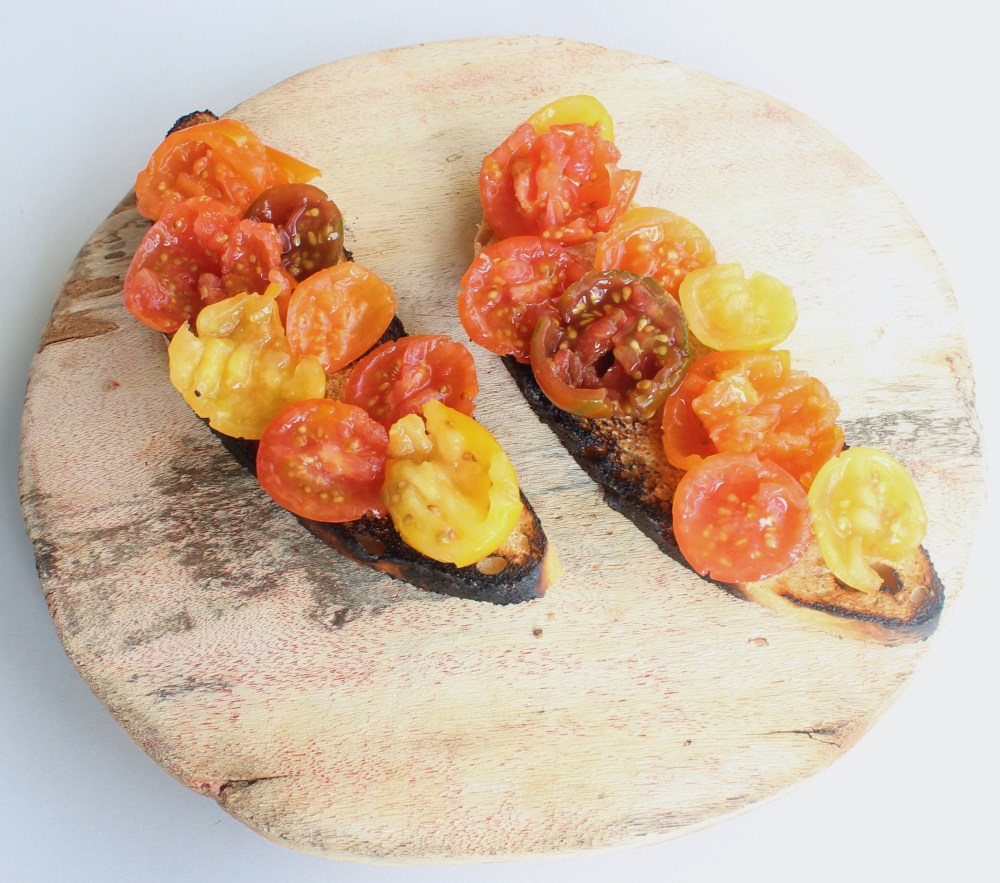
I love pan con tomate. I had it for the first time in Jaleo in Washington, D.C., and it was such a simple concept – crusty, airy bread, rubbed with raw garlic, garnished with juicy, crushed tomatoes, olive oil, and sea salt. So straightforward in the components, and honestly very refreshing and light! The perfect thing to eat in the summer, when tomatoes are in season. This recipe is Catalan in origin, and is featured in a lot of tapas-style restaurants because of that. I wanted to try my hand at it, with trying my best to keep true to a lot of the original aspects of the dish. The fresh tomatoes, the garlic, olive oil, and some sea salt adorn the bread. With the tomatoes, I did use heirloom cherry tomatoes to be a little more colorful, and since the skins can be a little annoying to eat on those, I chose to blanch and shock the cherry tomatoes so that they can be popped right out of their peels, and pressed straight onto the bread! The garnishes on top are relatively easy to prepare, and I was able to get that all ready, even the blanching, shocking, and peeling of the cherry tomatoes, ready in probably 15 minutes, tops. The bread recipe, that is what probably sets this recipe’s difficulty level all the way up to 10. Now, if you want to enjoy pan con tomate without the suffering, just buy some bread, or use a different bread recipe. I wanted to embrace Spanish and Catalan cuisine, so I opted to make glass bread, which has been dubbed the hardest bread dough to make, and with good reason for that.

Glass bread, or as I will forever remember it as, nightmare loaf, is a bread dough made with a really high amount of water – since it is made with equal parts water and flour, the bread is 100% hydrated, in bread-making terms. Now why is adding so much water to a dough so difficult? Because the higher the liquid content in a dough, the harder it is to knead, and the harder it is to develop gluten for the bread to bake in a firm shape in. Most bread doughs usually call for 50 to 60% hydration, which makes the dough a lot more manageable to shape and knead. Since this recipe calls for double the hydration, the dough honestly starts more like a batter. And being aggressive with it can knock air out of the bread, resulting in the loaf baking up dense, instead of with these gorgeous air pockets – and you can only get really large air pockets in your bread loaf from having high amounts of liquid in it. Fun fact, glass bread gets its name because the cross section of the bread had those air pockets that are so large that you can see throw them, like a window pane. Not so fun fact, if you choose to make this recipe, expect to spend about 5-6 hours of active time gently folding and resting this dough. It’s almost laughable(if I wasn’t too busy crying) how much time needs to be spent on the dough itself, so again, if you value your life, just either make a ciabatta dough or buy some bread. If you are a masochist for making bread doughs that will make you question your existence, then let’s proceed to the recipe.
For the glass bread:
425g water, in three parts
1g active-dry yeast
2g sugar
425g bread flour
20g olive oil
In a bowl, mix one part of the water with yeast and sugar, and let sit in a warm place for 10 minutes. Once the yeast is frothy, mix into that your flour, and begin kneading the dough until it is firm and elastic – I left my dough going for about 15 minutes in a stand mixer with a dough hook attachment on high speed. At that point, transfer the dough to a bowl, and mix in one part of the water, and the olive oil. Then mix into that the remaining water. The dough will loosen into essentially a batter at this point. From here, you will carefully transfer the dough into a square baking container that is lined with more olive oil. Let the dough sit, covered in a warm place, for 20 minutes. Then gently fold the sides of the dough towards the center, brochure style, and flip the dough so that the folds are underneath the dough. Place back in the tray, and let sit in a warm place for another 20 minutes. You will be repeating this folding and resting process for a total of 12 times(including the two times that were already listed in this recipe). The dough should be a lot firmer by then. Divide the dough into 4 loaves. Dust the exterior generously with flour, and transfer the loaves onto a lined sheet tray. Let the loaves sit at room temperature, in a warm place, for another hour, before baking them at 500 degrees F for 35 minutes. Allow the bread to cool down before slicing 1/2 inch-thick wedges. Optionally you can toast the wedges.
To garnish:
1 clove of garlic
Heirloom cherry tomatoes
Olive oil
Flaky sea salt
Score the cherry tomatoes and blanch them in hot water for 10 seconds. Shock the tomatoes in ice water, and then remove the peels.
Rub each slice of bread with the garlic clove. Halve the tomatoes, and then using a fork, press them onto the bread slices, and garnish the tops with olive oil and flaky sea salt.
 Freddy's Harajuku